Daily life in Castel Roc
Castel Roc is a project for an inhabited medieval village in Mauricie, Québec: a place where people would live every day among stone, oak and linen, not just for the length of a festival. Days shaped by handwork, the market, shared meals and evenings by the fire: here is that life as the 3D model and the show interiors of the demo village depict it.
The project is in development and the village shown here is a fictional demo: its places, its villagers and their names are invented. The pictures are taken from its 3D model.
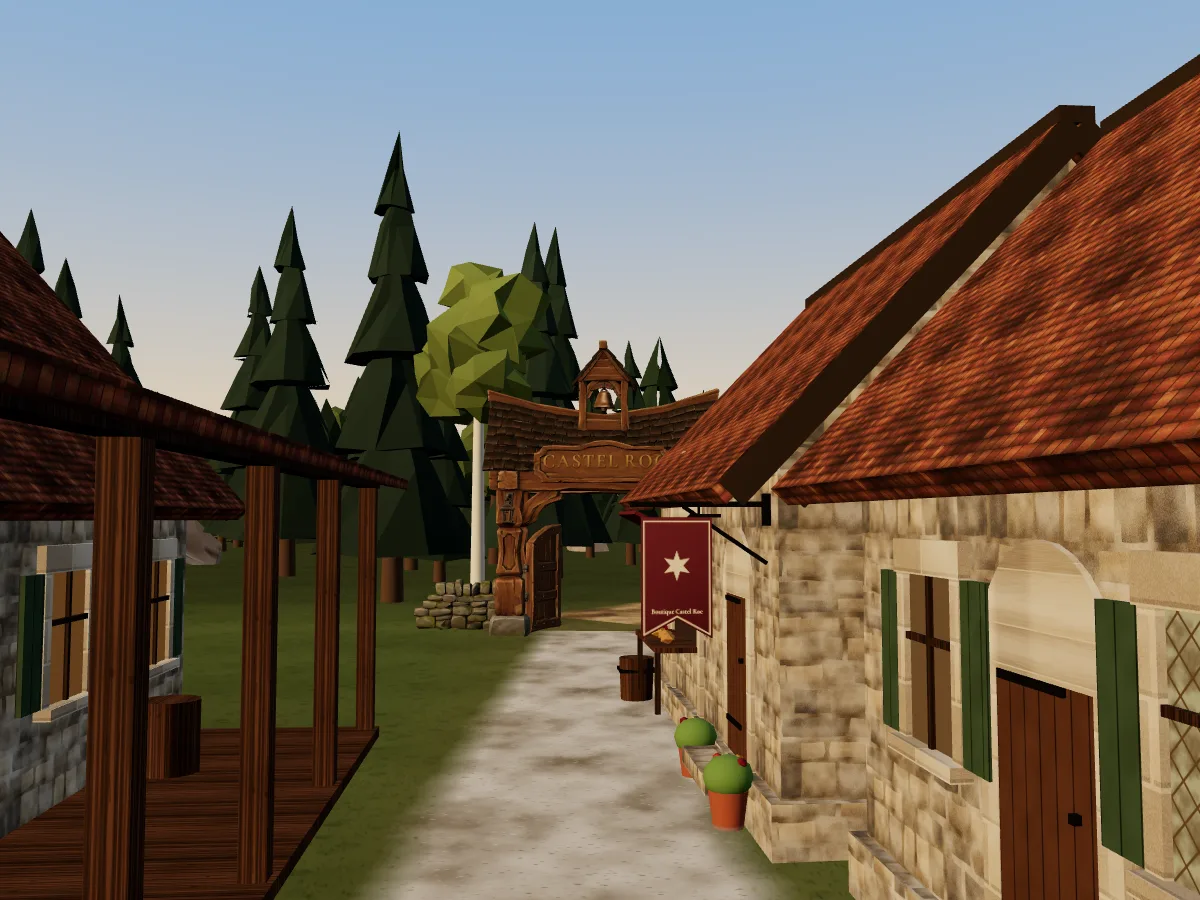
Crossing the threshold: leaving your century in the parking lot
The day begins on the far side of the forest. The car stays in the parking lot; phones and screens stay safely in the Threshold House cloakroom. The wardrobe lends period clothing, in linen and wool, unless you bring your own, as long as it suits the period.
Then you walk in: past the timber gateway, a trail crosses the forest, then the fields, and goes over the stream to the village gate. Beyond it, public life goes on with no visible technology. Inside private homes, the place of technology is still to be defined with future residents: no rule has been set to date.
On the market square, around the well
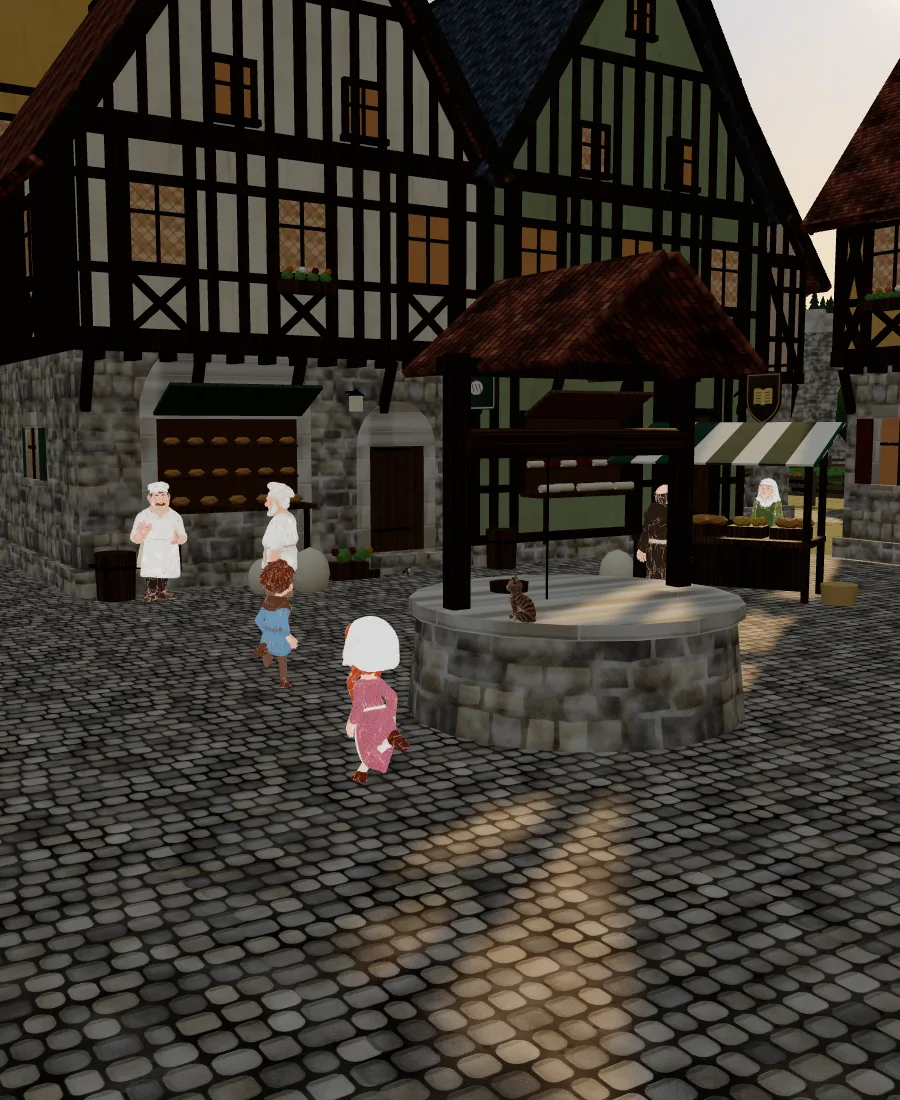
Every street leads to the market square, lined with half-timbered houses: a well, a great linden tree and the stalls of growers and craftspeople. In the model, children play around the well, the spice merchant sets out her baskets and jars, and two stalls stand side by side, one with fruit, jars and kegs, the other with spices in crates and baskets.
Gaucher le Crieur, the town crier, announces the news of Castel Roc to anyone who comes near; Barthélemy le Lombard, the money changer, stands at his barrel, his small brass scales at hand; the miller’s cart comes to deliver flour to the bakery.
Facing the well, the show grocery lines up its jars, fruit and vegetables, and Margot du Puits serves her customers; at the corner of the square and the Grand-Rue, the show bakery opens its stall onto the street, in front of the counter and the bread oven.
Working with your hands
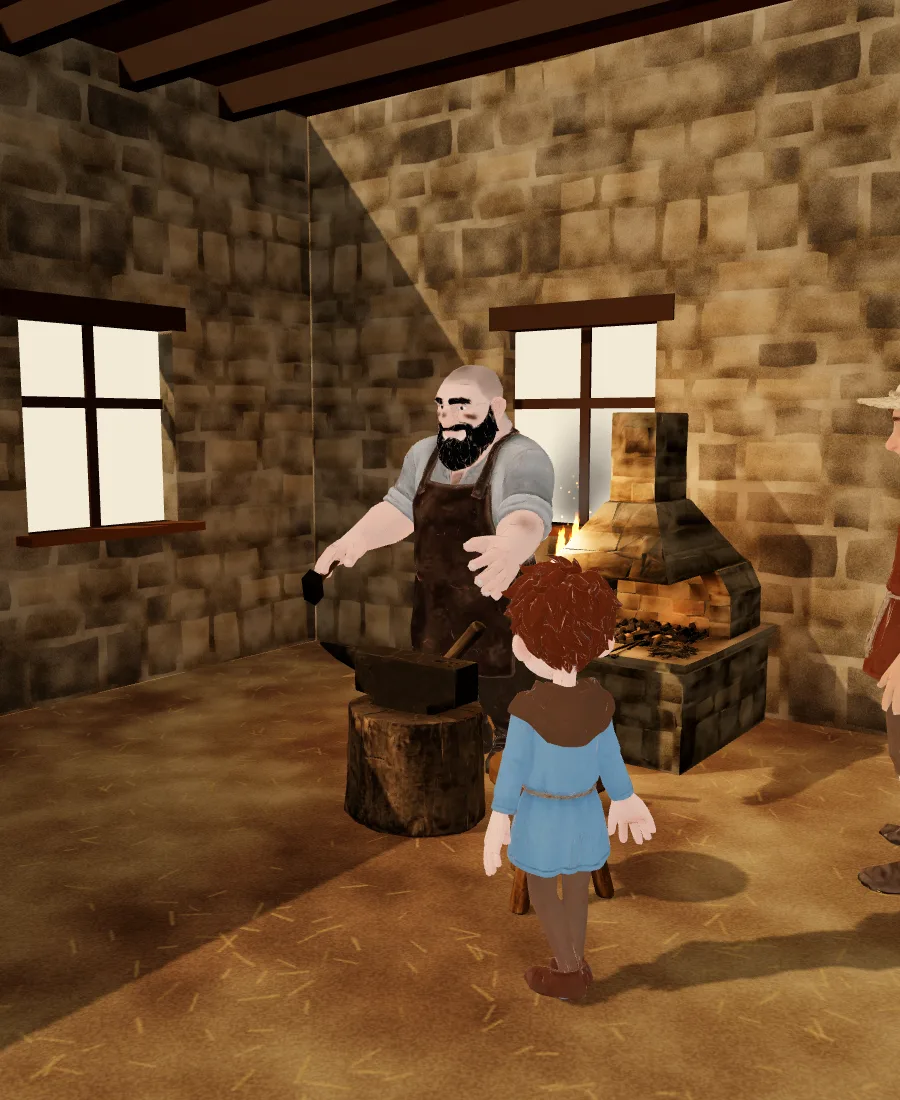
The forge, woodworking, pottery, weaving: skills that are practised and passed on. On the rue des Artisans, which leads to the East gate, the forge, the wood workshop and the potters’ workshop stand wide open by day: you can walk in on the walking tour, and Thibaut le Fèvre, the blacksmith, shows the anvil to a young apprentice.
In the streets, every shop has its trade, told by its sign and its wares: baker, grocer, shoemaker, weaver, chandler, potter, bookseller, goldsmith… The shop is on the ground floor, open onto the street, and the home upstairs. Beyond the walls, the miller, the farmers, the shepherds, the woodcutters and the charcoal burner keep the countryside alive.
Bread and the table
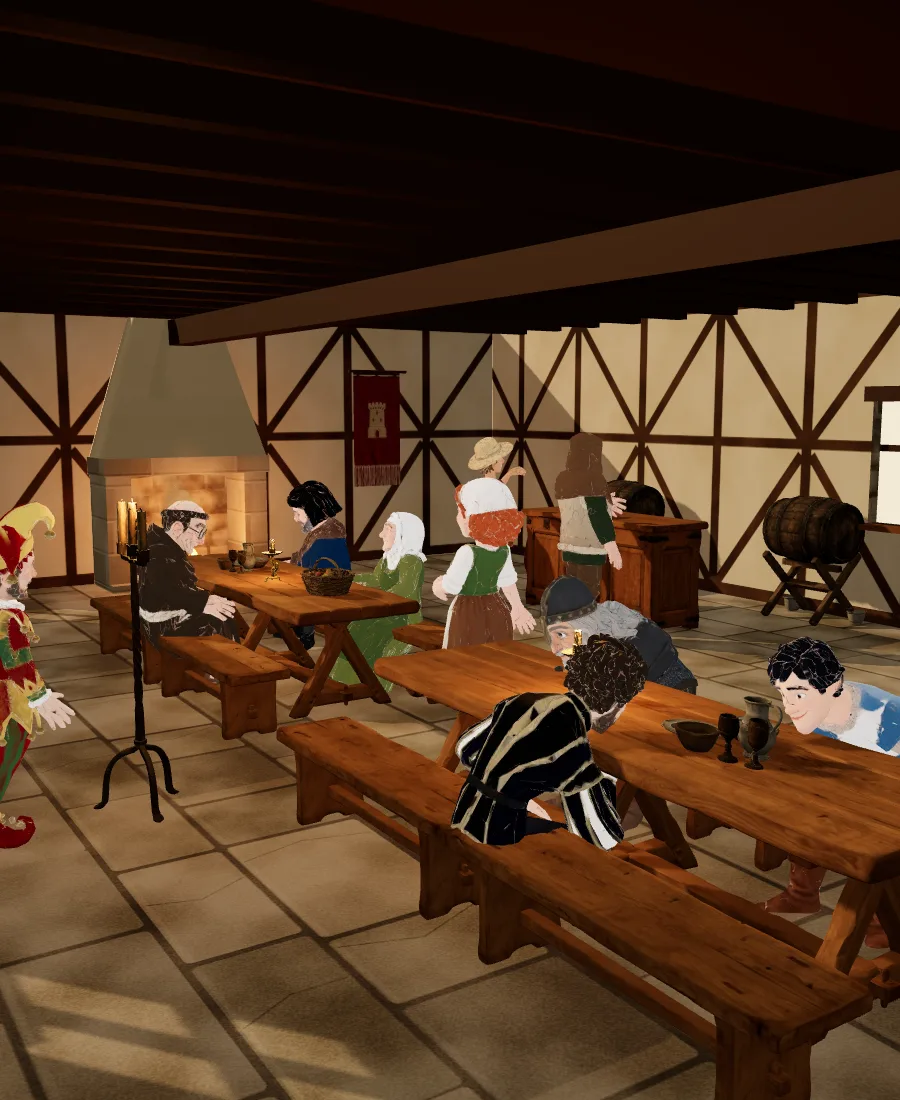
At the tavern or the inn, long tables where people take their time. The Bear Tavern, on the north side of the square, has its long hall, its great fireplace and, on summer evenings, its benches outside; Hugues de l’Ours draws mead from the barrel there, and on the walking tour you can have him pour you one at the counter. The Castel Inn, the largest house on the Grand-Rue, gathers meals in its great hall and puts travellers up in its rooms.
Bread comes from the bakery: in the show shop, Mathieu le Fournier serves his customers behind the oak counter and its scales, between the kneading trough, the bread oven and the shelf of the day’s loaves.
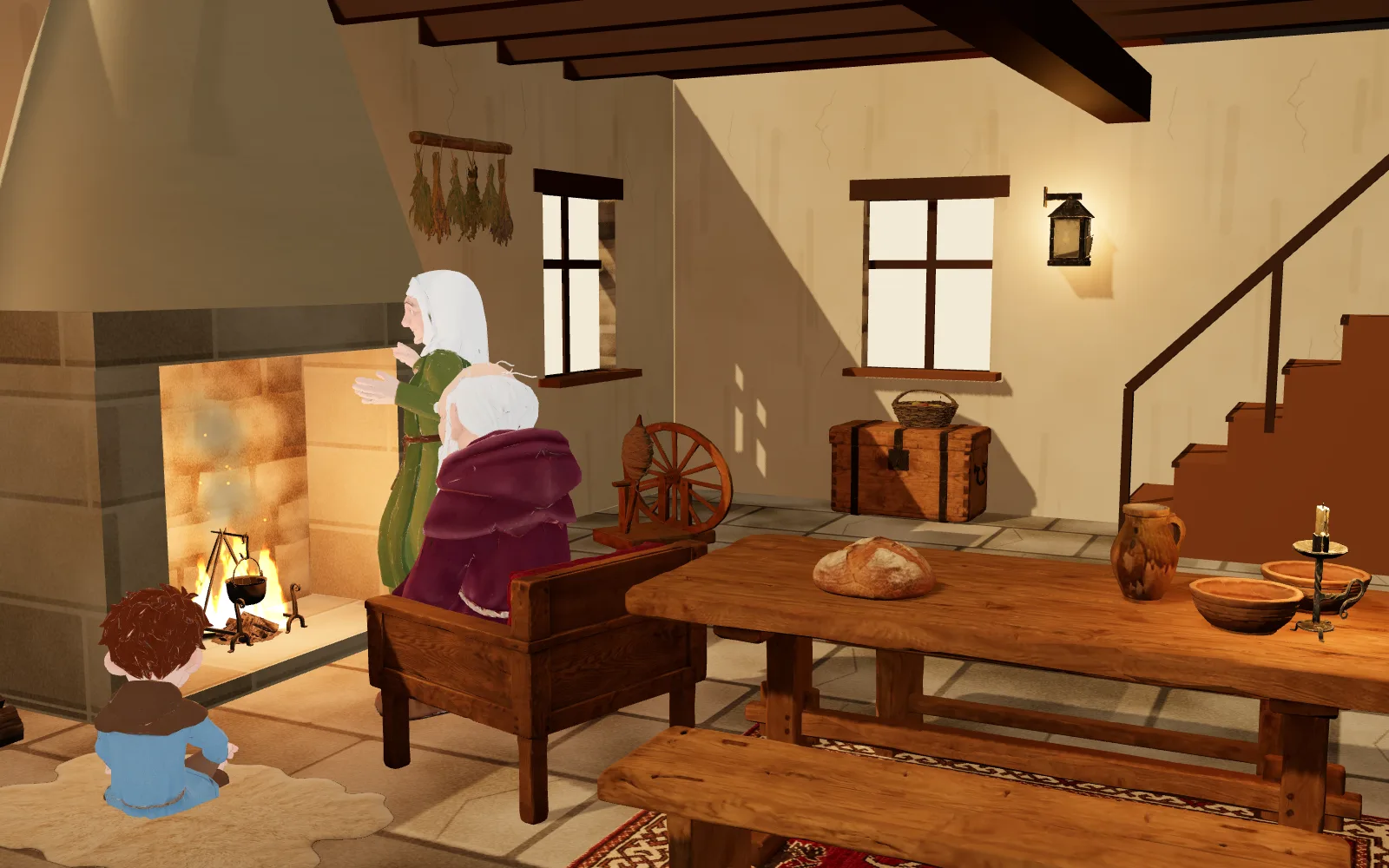
At home: the common room and the hearth
In the Linden House, the show home, at the corner of the square and the rue des Jardins, life happens in the common room: the hearth and its pot, the laid oak table, the dresser, the spinning wheel by the fire; the bedroom is upstairs. A family lives there and bears its name: the old man of the Lindens sits by the fire, a child plays in front of the hearth.
The houses of the demo village are tall and narrow, packed around the square and along the Grand-Rue, their upper floors jutting out over the cobblestones. Each one can be chosen and customized in 3D: furniture, finishes and sign.
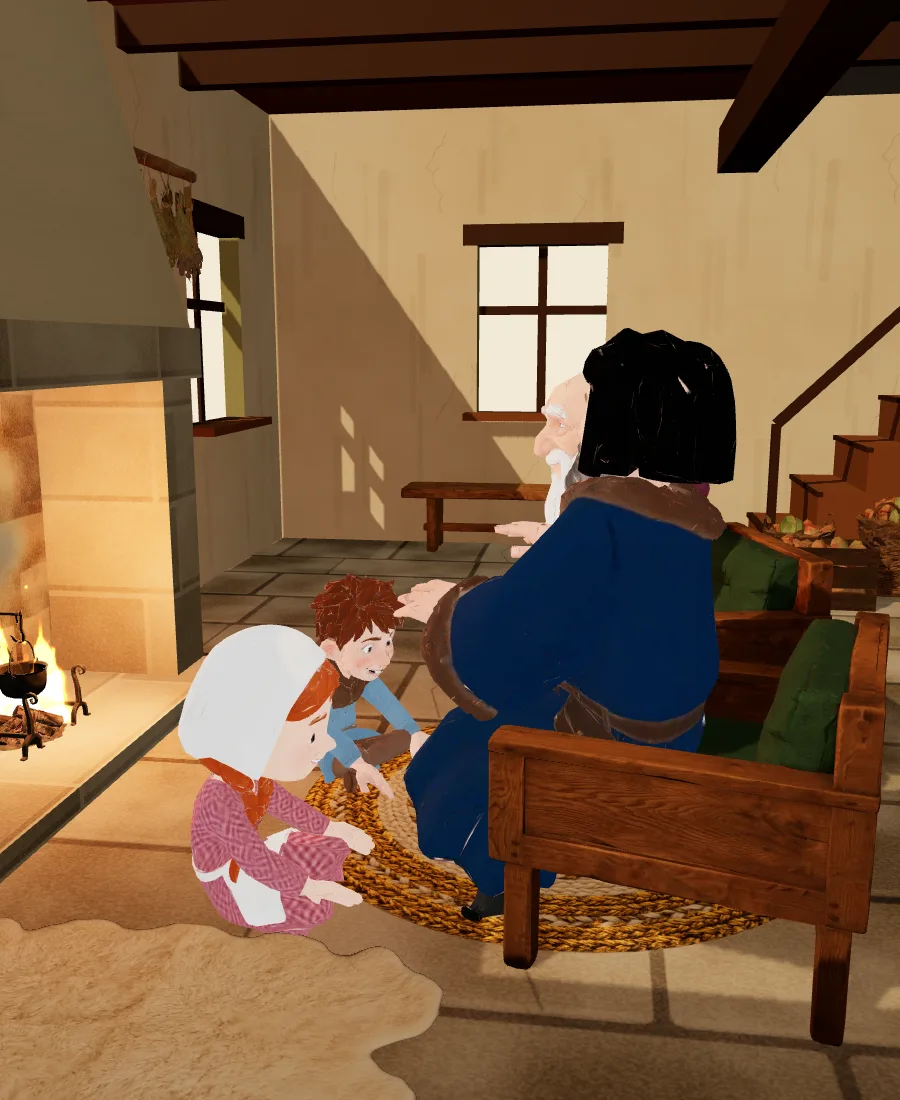
Evenings and feasts
The fire in the hearth, the spinning wheel, the stories: evenings are spent together. On a feast night at the Bear Tavern, the band plays on its stage, bagpipe, pipe, drum and tambourine; the ring of dancers changes dance with the music, the drinkers keep time at the counter, the serving girls pass with their trays and the roast turns golden on the spit in the hearth.
In the towers of the walls, the project envisions evenings of another kind: the Storytellers’ Tower for tales, acoustic music and small performances, the Games Tower for chess, table games, dice and role-playing evenings, the Star Tower for watching the sky with the naked eye.
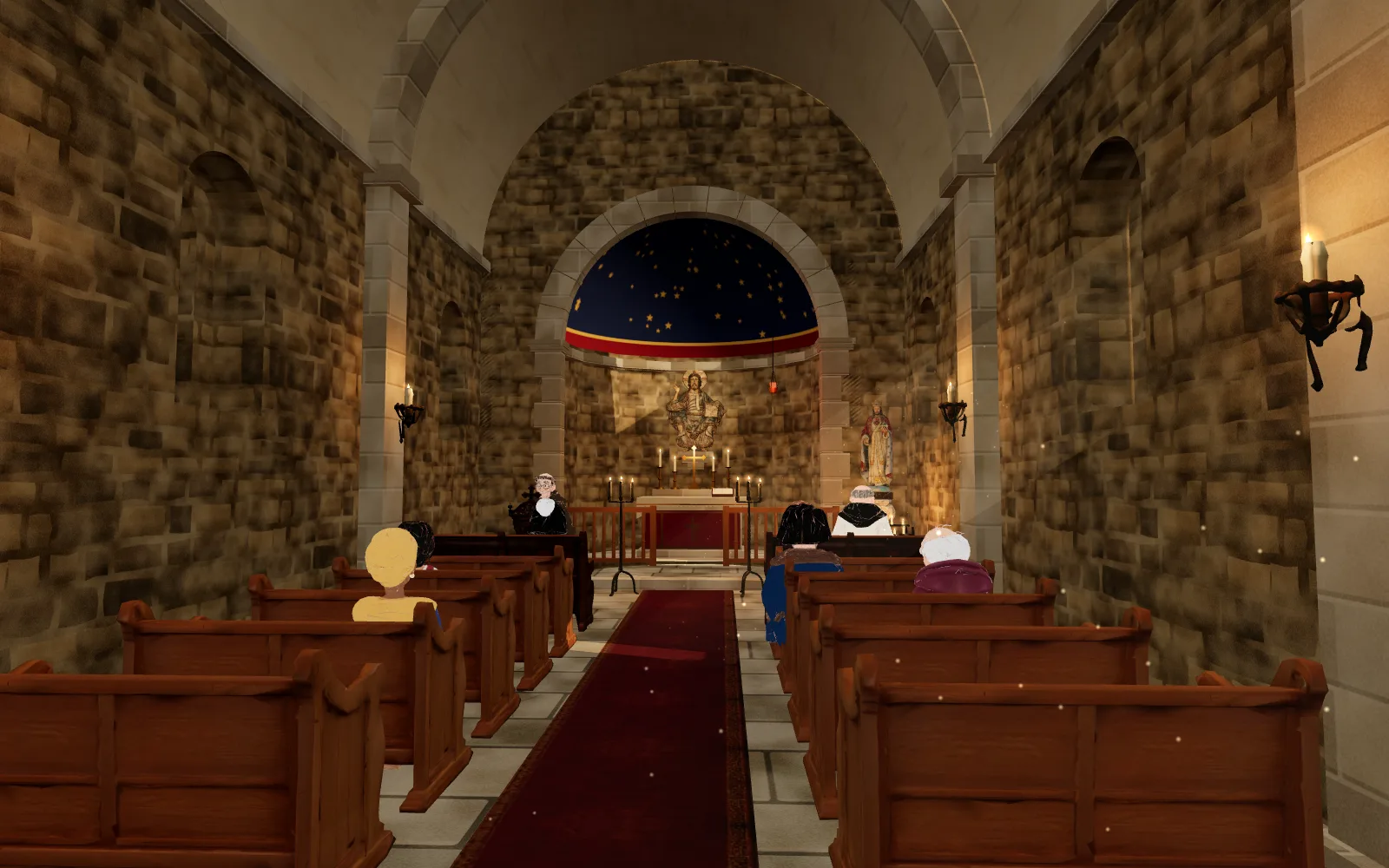
Life in common
Behind the houses of the rue des Jardins, the shared gardens: plots of vegetables and herbs, straw beehives and a tool shed, tended together. Just outside the East gate, a monk comes to check on his hives.
For community life, the project envisions the Council Tower, next to the East gate, for residents’ meetings and ceremonies; the Book Tower, a quiet library; four lookout towers open to all, the Sunrise, Forest, West and Sunset towers, with their wall-walk; and, in the lower courtyard of the keep, the Great House, for long tables and village feasts.
The Romanesque church, planned for the village’s extension, can be visited as an artist’s view: the pale stone nave under its vault, the stained glass, the apse; a monk reads at the lectern. On its rock, the keep, which can also be visited as an artist’s view, would hold the banquet and meeting halls and, at the very top, the estate office. The detailed use of both is still to be defined.
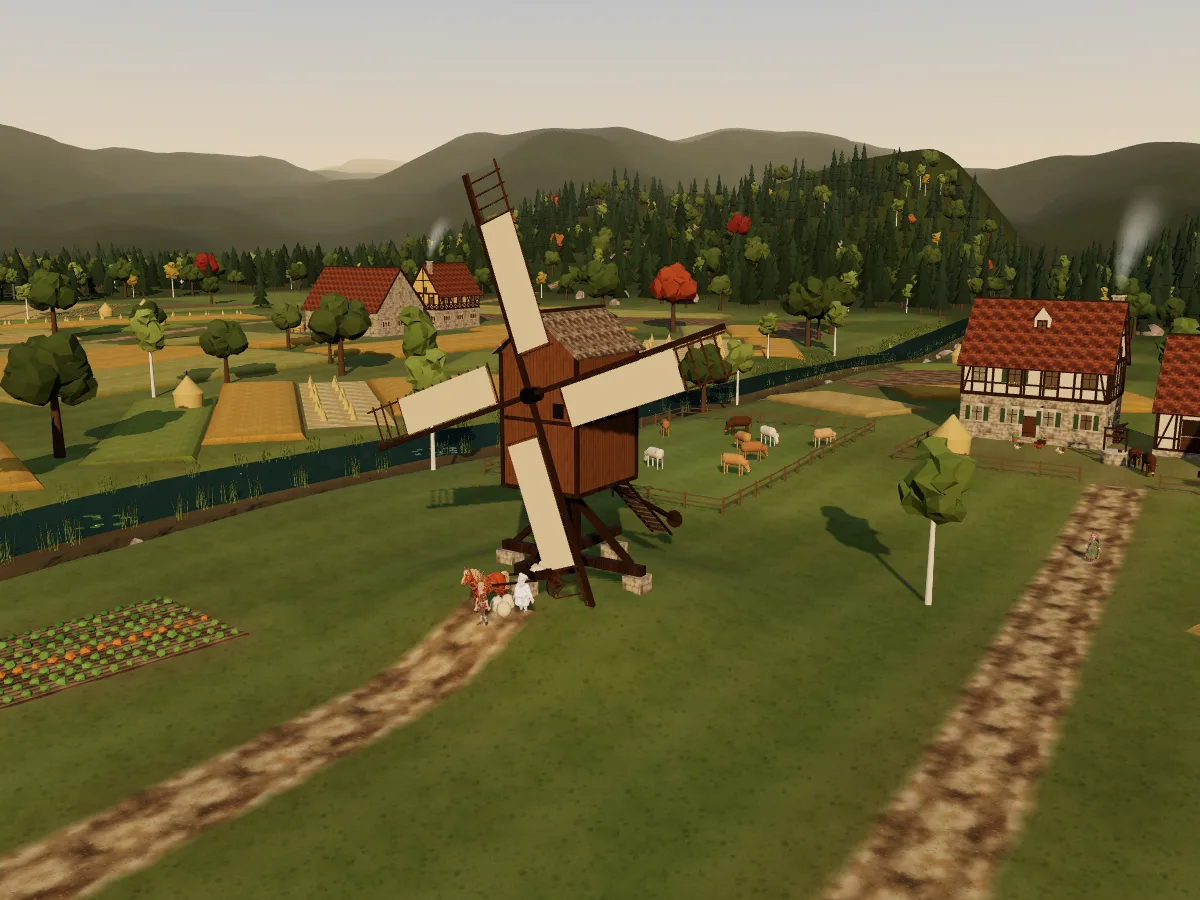
Beyond the walls, the countryside
A countryside keeps the village alive. To the west, the Vale Sheepfold, its thatched roof and its orchard meadow where sheep graze under the apple trees; south of the stream, the Streamside Farm, its byre and dairy, its cow pasture running down to the water; on the East road, the Grange Farm and its farmyard. Between them, fields of wheat, barley and oats, vegetables and hay meadows in long strips, and the windmill on its mound.
The shepherd leads his sheep, the mower works in the barley, the fisherman waits on his jetty; at the edge of the forest, the woodcutter splits his log on the block, near the charcoal burner’s mound. Now and then, the hunter goes out through the South gate to try his luck with the bow, and sometimes brings a doe back to the butcher on the rue Neuve.
Deeper in the woods, the fortune-teller, who is also a herbalist, waits for visitors outside her hut, her herbs drying; a pilgrim walks to a lost grave in front of the ruins of the abbey of Saint-Polycarpe; in the bend of the East road, the travellers’ camp keeps its fire burning day and night.
The people of the village
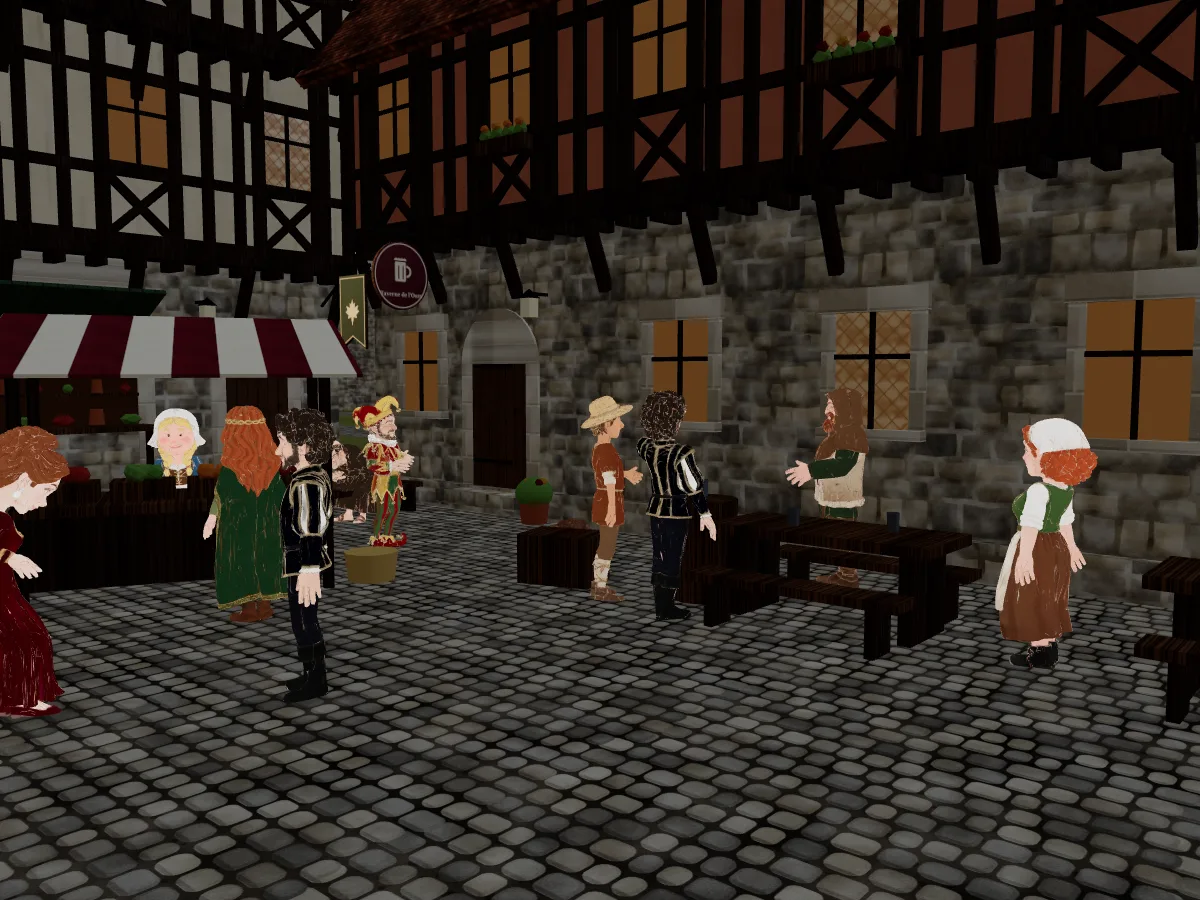
Some forty villagers, dressed according to their station, bring the model to life: merchants behind their stalls, drinkers outside the tavern, monks, guards at the gates, the lady of the castle in the lower courtyard; now and then, a knight and his squire ride out of the forest and climb to the keep. They pass the visitor as one of their own and answer the visitor’s gestures: a wave, a bow, a cheer for a dance.
Each has a medieval name, shown with their trade on hover: a period first name and a byname drawn from a trade, a place, a trait or an origin. A fictional village: these people do not exist.
When night falls
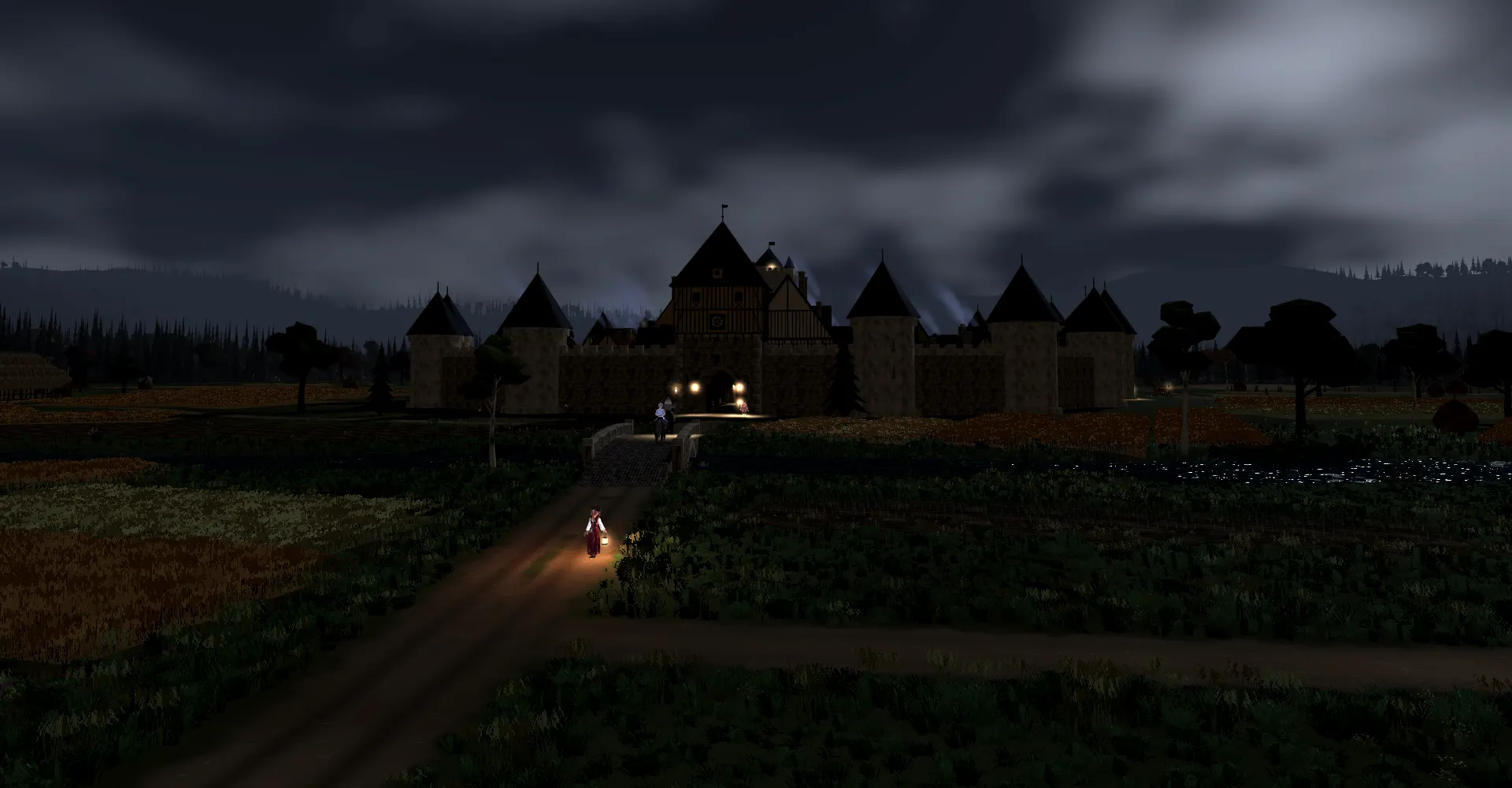
The village opens by day, but you can see it at midnight: the “Night” button on the map and on the walking tour makes the sun set, then night fall, under a full moon.
The village sleeps. The shops have closed their shutters, stall and awning brought in; an oilcloth tarp covers the stalls on the square; the forge and the workshops have pulled their doors shut. Only a few windows are still awake by candlelight; the Bear Tavern and the inn stay lit, and torches burn at the gates of the walls, where the guards make their rounds by torchlight.
Sheep, cows and hens are back inside, and deer come out of the woods. The market and the forge fall silent; you hear crickets, an owl in the distance, toads by the stream. At the travellers’ camp, around the fire, a woman sings and Mathurin the Fiddler plays along. On a free walk, you find your way by the light of your lantern.
Through the seasons and the weather
The model follows the date and the weather. Its weather is the day’s weather in Mauricie, updated every fifteen minutes: sky, light, mist, rain, snow on the ground and on the roofs, storms and wind, which shows in the smoke and the windmill’s sails. A “Fair weather” button brings back the presentation weather.
When winter comes, the linden and apple trees are bare, the vegetable plots empty; nobody works the fields any more, the frozen stream falls silent and the fisherman leaves his jetty; under the snow, sheep and cows go indoors. During the holiday season, a Christmas market sets up on the Fairground, the large meadow by the parking lot where the project also envisions craft markets, shows and large gatherings, around a covered stage and wooden chalets.
Who is it for?
The project speaks to those who would like to find their place there:
Lovers of the Middle Ages
Living every day among stone, oak and linen, not just for the length of a festival.
Craftspeople
A workshop on the street, and customers who take the time to appreciate work well done.
Those looking for a community
Neighbours you know, shared tasks, a place in a living village.
Those who want to slow down
When everything speeds up, finding a human pace again, simple gestures and conversations without screens.
See for yourself
The demo village can be visited online, in your browser: the 3D map, the walking tour, six show interiors and a role-playing game. And if you feel like living there, let us know: it is simply getting in touch, with no payment or reservation.
What is described here is envisioned: the village shown on this site is a fictional demo, and nothing is confirmed.