The village trades
Baker, blacksmith, potter, weaver, shoemaker, chandler, goldsmith… In the demo village of Castel Roc, a project for an inhabited medieval village in Mauricie, Québec, every shop has its trade, told by its sign and its wares, every workshop its craft, and the countryside its farms and its mill.
The business shown is only an example: the occupant chooses their own and its sign. Businesses, layouts and villagers are illustrative: none is confirmed.
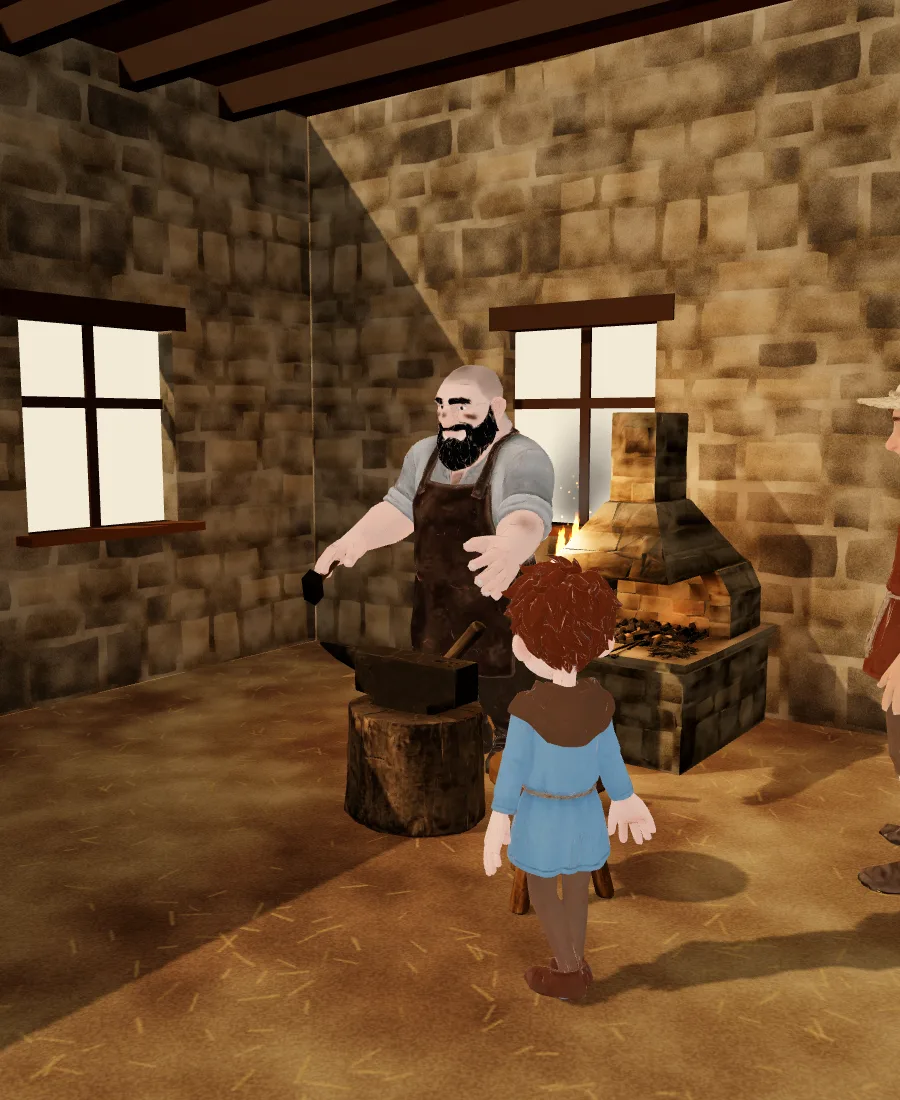
Rue des Artisans: the forge, wood and clay
The rue des Artisans runs from the square to the East gate. It gathers three workshops, wide open by day, which you can walk into on the walking tour; at night, they pull their two doors shut.
The Forge is a stone workshop with a high ceiling and a great carriage door: Thibaut le Fèvre works at the anvil there and shows the craft to a young apprentice. The Wood Workshop, the largest, half-timbered, has its yard where timber dries: joinery, carpentry or cabinetmaking; the carpenter hammers away at his workbench. The Potters’ Workshop, full of light, at the end of the street, has its lean-to for the kiln: pottery, ceramics or glassmaking.
In the game, the forge runs short of charcoal: you have to fetch it from the woodcutters’ camp, where you learn to read the smoke of a charcoal mound.
Walk into the workshops on the walking tourCastel Roc, the game
See on the map
- The Forge — A blacksmith’s or ironworker’s workshop.
- The Wood Workshop — Joinery, carpentry or cabinetmaking.
- The Potters’ Workshop — Pottery, ceramics or glassmaking.
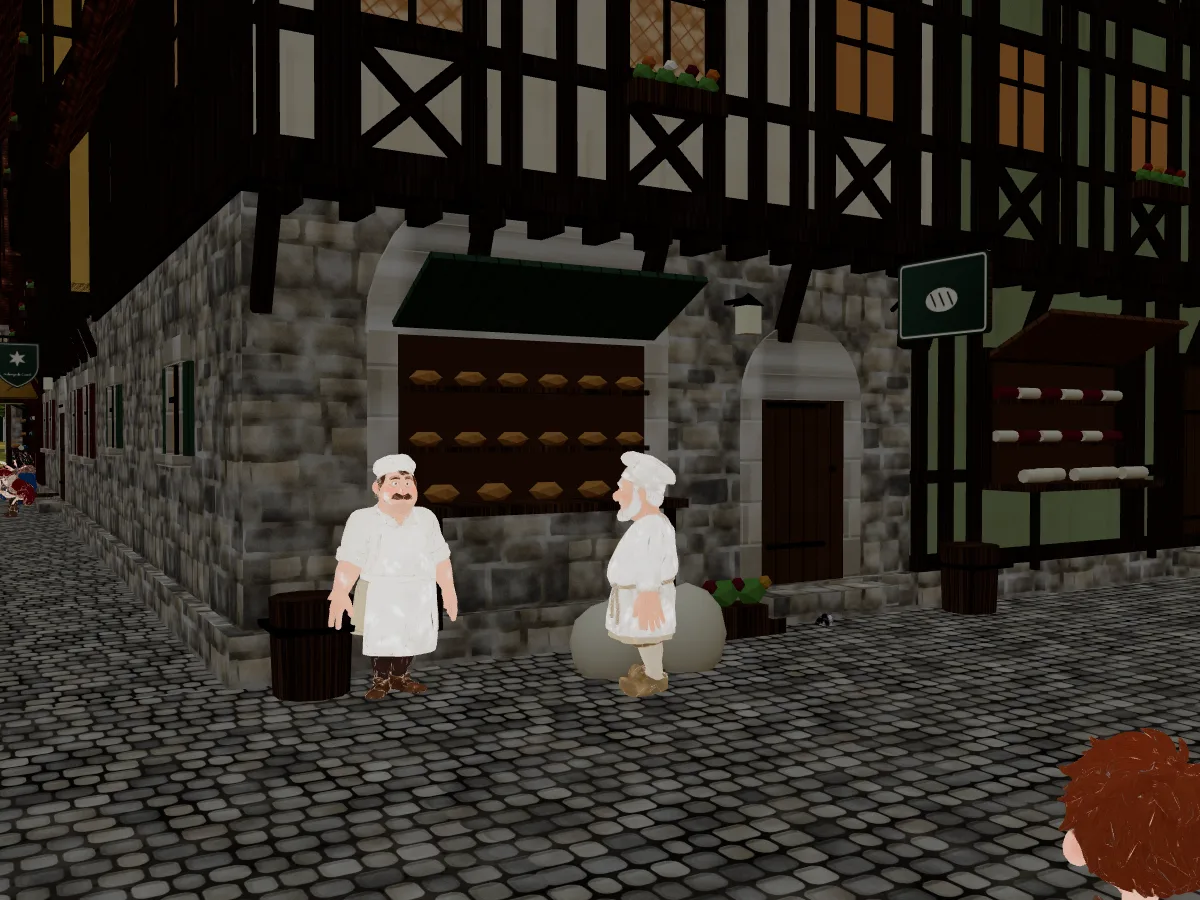
Bread, flour and the grocery
Wheat grows in the fields of the Grange Farm; Gilles du Moulin grinds it in his post windmill, which is turned to face the wind, and his cart delivers the flour to the bakery.
In the show shop, the Grand-Rue Shop turned bakery, Mathieu le Fournier serves his customers behind the oak counter and its scales; the kneading trough, the bread oven and the shelf of loaves are close by, and the family’s home upstairs.
Facing the well, the Well Shop, a fish on its sign, has become the show grocery: shelves of jars, fruit and herbs, strings of garlic and chillies, kegs; outside, crates of herring and red mullet. Margot du Puits serves her customers there.
In the game, the bakehouse runs out of flour: from the Grange Farm to the mill, then to the baker, you go round the whole estate.
The shops and their trades
27 shops, on the market square, the Grand-Rue and in the village streets: the shop on the ground floor, open onto the street, the home upstairs, to rent together or separately. Here are their trades in the model; each one leads to its card on the map.
Behind their stalls, the shopkeepers show their trade on hover: the shoemaker and his apprentice, the weaver, the herbalist, the goldsmith, the jeweller, the chandler…
Bakery
The counter on the street, the shelf of round loaves, the kneading trough and the baskets; the bread oven in the show shop.
Grand-Rue Shop (the show interior: Grand-Rue Shop), Bakehouse Shop, House at 5, rue Neuve
Grocery
Shelves of jars, fruit and herbs, a stall of vegetables and tomatoes, strings of garlic and chillies, kegs.
Herbalist
Spice drawers, shelves of pots, jars and bunches of herbs hung to dry.
Sunrise Shop, Three Keys Shop, House on the Square, The Apothecary’s House, East House
Bookseller and scribe
The scribe’s desk, the shelves of books, the brass candelabrum.
Belfry Shop, Corner House, Tall House, House at 6, rue Neuve
Cloth merchant
The counter with drawers, the madder-red cloth rack, the folded lengths of wool and linen.
Tailor
The scissors on the sign, the lengths of wool and linen on the counter.
Seamstress
The needle on the sign, the loom and the spinning wheel in the shop.
Weaving
The loom, the spinning wheel, lengths of cloth waiting on the rack.
Potter
The wheels, the shelves of pieces left to dry, the terracotta jars.
Shoemaker
The shoemaker’s bench and stool, the shoe display, the hides and the boots.
Chandler
The vat where wicks are dipped, the hanging candles, the cabinet and the shelf of tapers.
Goldsmith
The counter and its scales, the workbench, the shelves of silver plate.
Jeweller
The counter with necklaces and bracelets, the caskets, the enamelled lamp.
Armourer
The racks of swords and spears, the shield display, three suits of armour.
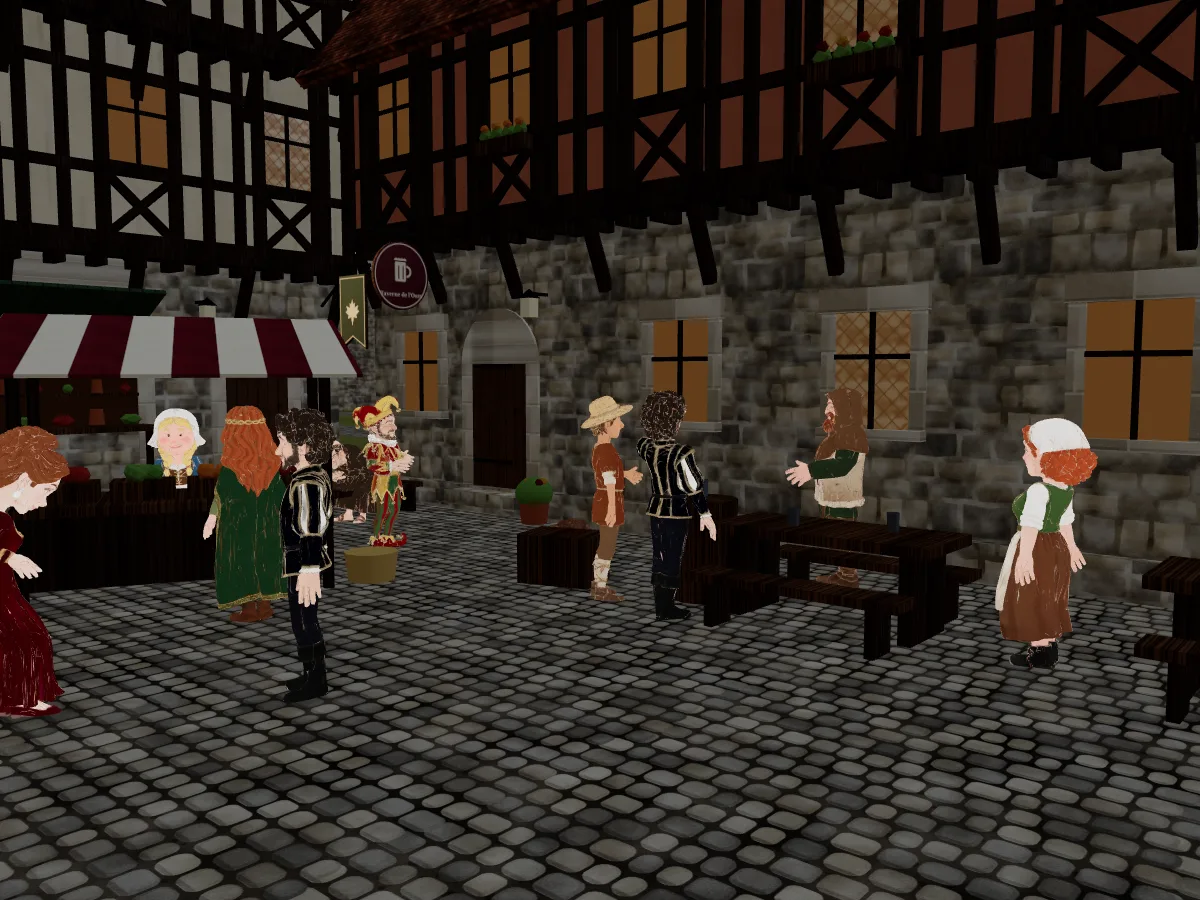
The stalls of the square and the rue Neuve
On the square, the spice merchant, Leïla de Tyr, sets out her baskets of spices in front of her stall, her jars and mortar on a table beside it. To the south-east of the square, two stalls stand side by side: under the red awning, fruit, jars and kegs; under the unbleached one, spices in crates and baskets.
Between the spice stall and the well, Barthélemy le Lombard, the money changer, stands at his barrel, his small brass scales beside him. In the Middle Ages, “Lombards” was the name given to the merchant bankers and money changers who came from northern Italy.
Near the Sunrise Tower, the potter keeps her stall and the armourer his booth, set against the rampart. On the rue Neuve, at the edge of the paving, the market gardeners sell pumpkins and potatoes, and the butcher has his stall and his game gallows, where the hunter sometimes comes to hang a doe.
On the square, Gaucher le Crieur announces the news of Castel Roc to anyone who comes near. At night, the stalls are covered with oilcloth, and the money changer has taken in his scales and his coins.
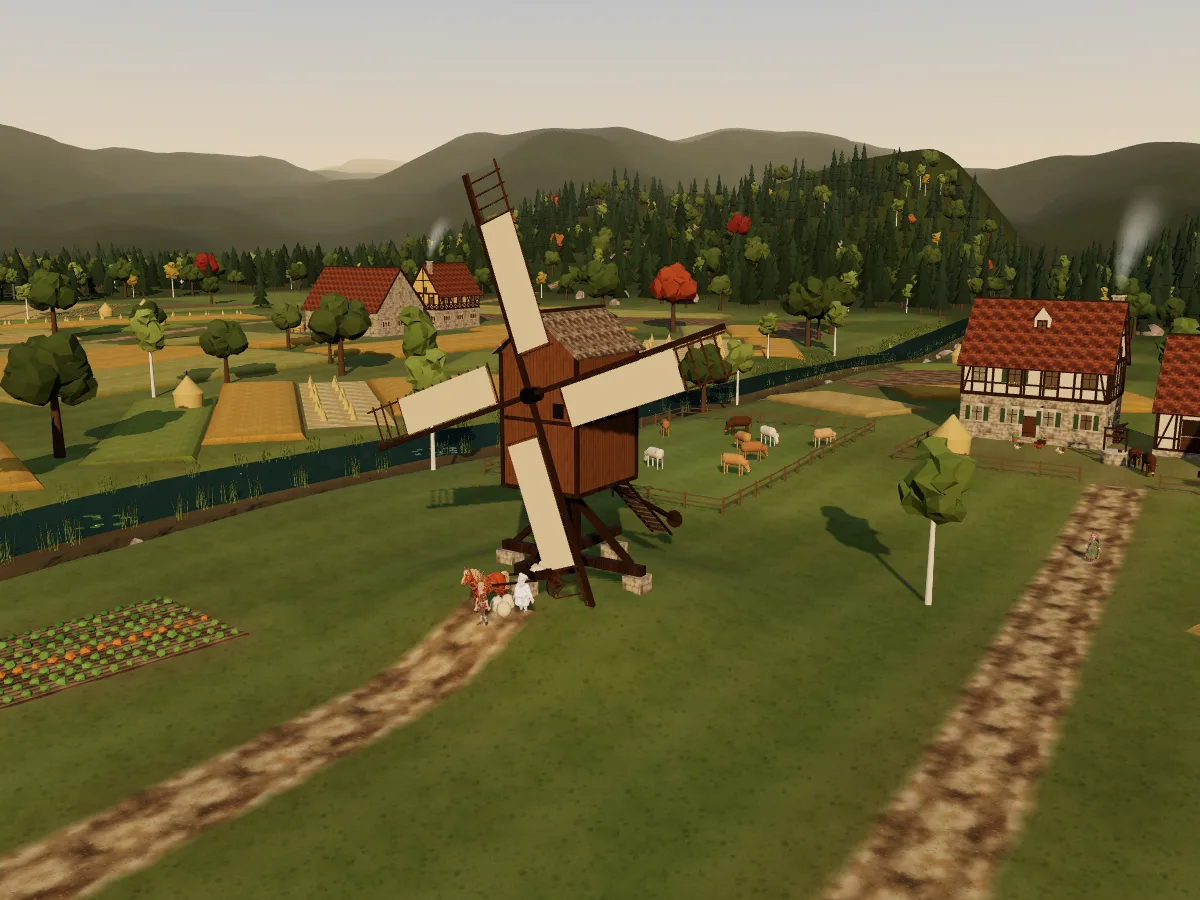
The trades of the countryside
Beyond the walls, the countryside has its trades. The miller, Gilles du Moulin, keeps the windmill; the Streamside Farm, a dairy farm, has its byre, its dairy and its cow pasture by the stream; at the Vale Sheepfold, the sheep graze in the orchard meadow and the shepherd watches over them, crook in hand; at the Grange Farm, the grain farm, the farmer stands in his yard; out in the fields, the mower works in the barley.
At the edge of the forest, in the woodcutters’ camp, wood is split on the block beside the piles of logs and the saw pit, and the charcoal burner’s mound smokes gently. The fisherman has his jetty on the stream; the hunter, Renaud le Veneur, stalks the herd at the forest edge, bow in hand.
In the demo village, the farms, the mill and the woodcutters’ hut are there to be taken over; the project also envisions tours and demonstrations at the mill.
See on the map
- The Streamside Farm — Dairy farm: a cow barn, a dairy and the farming family’s house; the cow pasture by the stream.
- The Vale Sheepfold — Sheep farm: a sheepfold, the farming family’s house and a fenced orchard meadow.
- The Grange Farm — Grain farm: a large barn, a farmhouse and a poultry yard; fields of wheat, barley and oats.
- The Windmill — A windmill on a pivot to grind grain from the estate’s fields; visits and demonstrations.
- The Woodcutters’ Cabin — Woodcutters’ camp: a log cabin, a felling and splitting yard, a charcoal burner’s mound.
Welcoming, feeding and entertaining
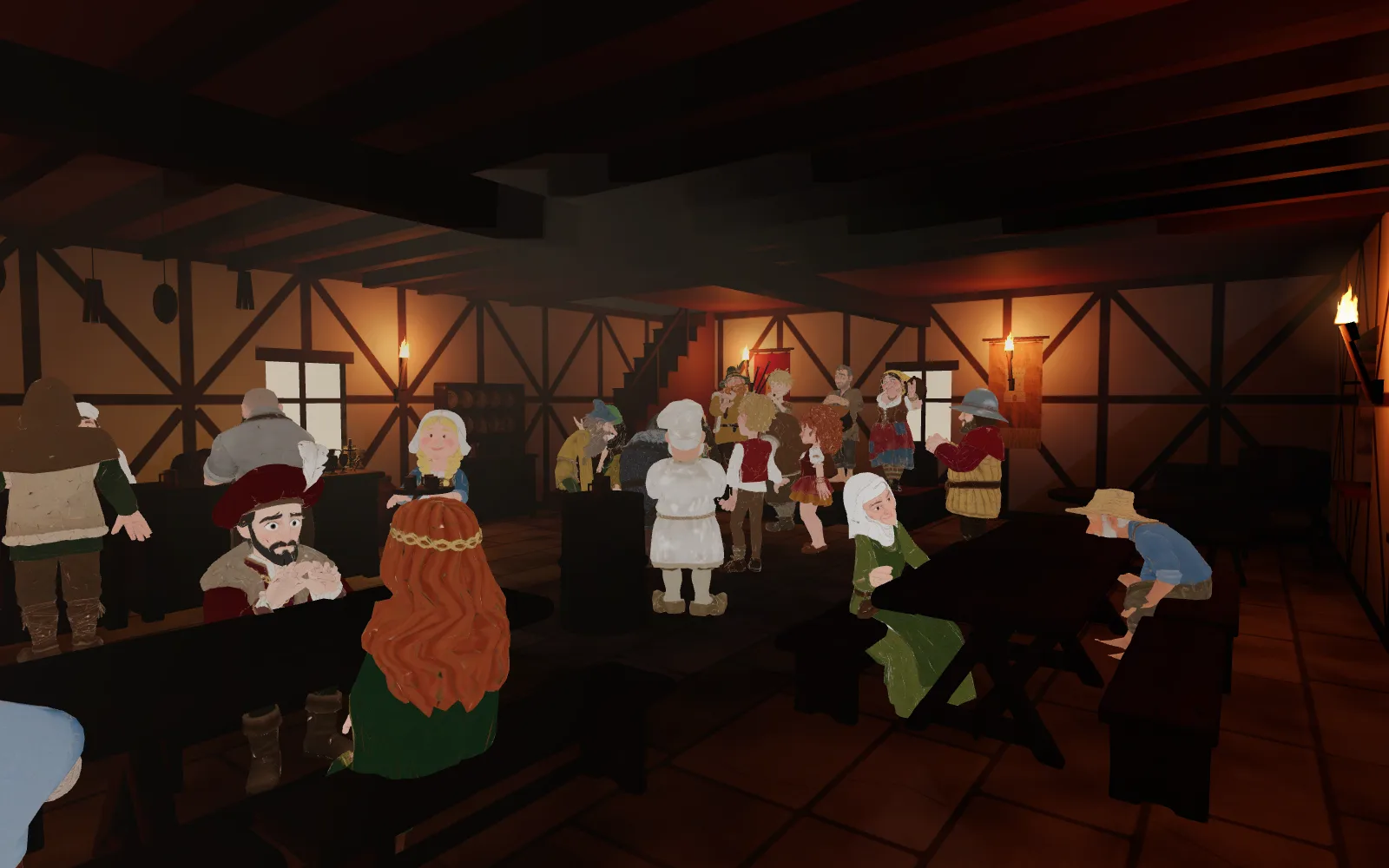
In the heart of the village, two houses are waiting to be brought to life. The Bear Tavern has its innkeeper, Hugues de l’Ours, who draws mead from the barrel, its serving girls and their trays and, on a feast night, its musicians, bagpipe, pipe, drum and tambourine, and even a jester. The Castel Inn has its great hall and two floors of rooms for travellers; at the stables, the stable boy takes the horses of the knight and his squire.
At the edge of the north-west woods, the fortune-teller, who is also a herbalist, waits for visitors at her round table outside her hut, her crystal ball and tarot cards laid out, her herbs drying; in the game, she asks you to gather the right mushrooms for her, and not the others. At the travellers’ camp, a woman cooks at the pot; at night, she sings by the fire and the fiddler plays along.
See on the map
- The Castel Inn — Inn: a great hall on the ground floor, rooms for travellers on the upper floors.
- The Bear Tavern — Tavern: meals, evening gatherings and music; the tavern keeper’s home upstairs. · The show interior: The Bear Tavern
Caring, passing on, keeping watch: the towers of the walls
In the towers of the walls, the project envisions care, a craft or an activity:
- The Physician’s Tower — Care for the sick and the injured, steps from the Apothecary’s House and the South Gate, through which they can be evacuated quickly.
- The Games Tower — Chess, board games, dice and role-playing evenings.
- The Scribe’s Tower — Calligraphy, illumination, notebook making and letters sealed with wax.
- The Book Tower — A quiet library, armchairs and small reading alcoves.
- The Star Tower — Naked-eye stargazing, star charts and evenings of astronomical tales.
- The Mystery Tower — An evolving puzzle tied to the history of Castel Roc, with objects, manuscripts and physical mechanisms.
- The Herb Tower — Discovering plants, drying herbs and making herbal teas.
- The Storytellers’ Tower — Tales, acoustic music and small evening performances.
Opening your own shop or workshop
In the demo village, every shop and every workshop can be chosen and customized in 3D: furniture, finishes and sign. On the Fairground, near the parking lot, the project also envisions market chalets for exhibitors. If a trade appeals to you, let us know: it is simply getting in touch, with no payment or reservation.
What is described here is envisioned: the village shown on this site is a fictional demo, and nothing is confirmed.